
All communication is persuasion; it is either well-placed or it’s misplaced. I use this statement to exemplify that even the most mundane statement is an attempt to get others to listen, at the least, and be prompted to act or change their views at the most. In my college courses, I offer ten points of extra credit to the person who can disprove the idea that all communication is ultimately an attempt to persuade. I have yet to award those extra credit points after roughly fifteen years of teaching similar courses. The value of information and informative speaking structures are important in the sense that they allow an audience to feel relatively less pressure to act. Persuasive speaking should influence people positively to take actions that will bring positive outcomes to individuals, groups, companies, communities, states, or globally.
Monroe’s Motivated Sequence
The quintessential schematic for tried-and-true persuasion is Monroe’s Motivated Sequence. Purdue’s Alan H. Monroe proposed the Motivated Sequence in the 1930s and perfected the approach following rigorous study of World War II era propaganda. The Motivated Sequence sounds simple, but when applied correctly will positively influence the audience to take an action that will be beneficial to them or their communities.
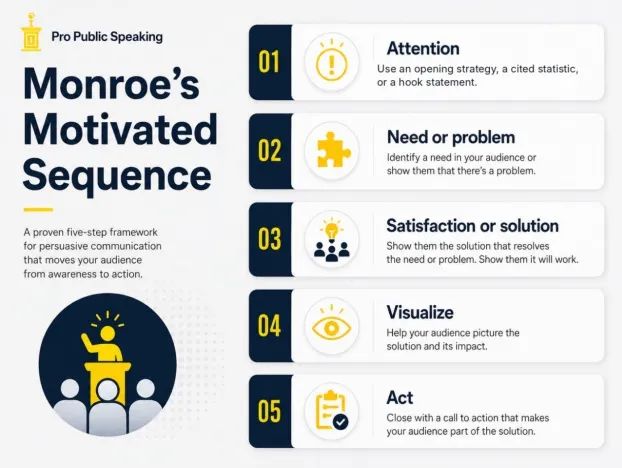
Steps for the Motivated Sequence
- Attention- The most integral step because if you have not hooked the audience within the first minute, they will not follow the logic of what is laid out later throughout the sequence. Use opening strategies: question, quote, rhetorical question, personal anecdote, cited statistic, or humorous reflection. The attention step is all about connection to general awareness within the audience. If you have prompted them to think, you have their attention.
- Need or Problem Statement- Illustrate to the audience that the problem exists and should not be ignored. Focus on the severity of the problem and how much immediate action can remedy future effects or consequences of ignoring an obvious issue.
- Satisfaction or Solution- Solve the problem for the audience in the most immediate way possible. Complex solutions can be explained or included but should not be the focus of this step. The focus should be a solution that can be implemented today, preferably as soon as the speech has ended. Small steps or simple solutions that build to a more complex resolution in the broad sense work here as well. The goal is buy-in to the inherent viability of an easy to enact action that can be taken with immediacy.
- Visualize- Use vivid description to provide the audience with a visualization of what their world will look like once the problem has been solved. Highlight the positive impacts of the solutions that have been implemented and outline how others will benefit from the problem being overcome.
- Act or Call to Action- A direct command directed toward what the audience can do today to solve the problem. The Call to Action should be a ‘You’ or (You) command. You should use Monroe’s Motivated Sequence for every persuasive speech you ever give. (You) Use Monroe’s Motivated Sequence to motivate others to make their world better!
Example Outline for Monroe’s Motivated Sequence
Attention (hook): French philosopher Voltaire was translated by Evelyn Beatrice Hall as having said: "I do not agree with what you have to say, but I will defend to the death your right to say it."
Need: The Chronicle of Higher Education surveyed Ivy League schools to find that roughly twenty percent of students would request sanctions on free speech on campus
Satisfaction: Freedom of speech is a primary right in the United States because it protects the right to thought and expression, outside of threats, that should be respected for its insightful approach.
Visualization: Imagine a world where we learn to embrace freedom of thought through recognition that speech is a conduit to meaningful understanding about the person speaking, for better or worse.
Action: Even if we disagree, defend freedom of speech for everyone's sake!
Ethics Must Be Considered
Ethics of any persuasion must be considered when Monroe’s Motivated Sequence is used to persuade people to take action. The purpose of this blueprint toward persuasion was meant to deter the unethical use of persuasive tactics, but as a professor and a professional speaker, I have seen many people attempt to pass off information that is either false or intentionally unethical. Here are some critical thinking tips to ensure that you are persuading ethically.
Tips for Ethical Persuasion
1. Ask the questions that consider ethics readily
- Who stands to benefit from this persuasion?
- Who stands to benefit from solving the problem?
- Who benefits from taking the action?
If the only answer is ‘the speaker,’ be skeptical as to whether or not the ethics of the persuasion have been considered fully.
2. Consider the consequences.
- Will this solution do more to help individuals or communities than hold potential to create unintended harm?
- Does the action that I am asking the audience to take directly benefit them or their communities?
- Have I thought clearly about the potential unintended consequences of persuading many people to take action to enact my solution?
If the world and the individuals in it stand to benefit from what you have to say and the goods outweigh the potential harms, your persuasion has been well considered.
3. Has the speaker properly explained and cited his or her motivations, reasons for pursuing action, and inspirations for solving the problem?
- Be skeptical of anyone who will not readily relay their motivations or inspirations to call others to action.
- Be skeptical of anyone who would ask you to take an action that they themselves have not taken.
4. Has the speaker justified the need to solve the problem?
If all of the above questions can be answered confidently to conclude that the problem has been justified and people will benefit from taking action to solve the problem, then the persuasion may be justifiable to a sufficiently ethical and critical thinker.